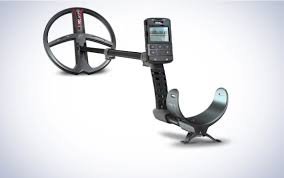
Every metal detector — whether it's a PKR 27,800 beginner unit or a quote-only professional gold machine — works on the same basic physics: electromagnetic induction. Understanding the basics helps explain why some detectors reach deeper than others, why ground conditions matter so much, and why a bigger price tag usually buys depth and stability rather than a completely different kind of technology.
The Basic Principle: Electromagnetic Induction
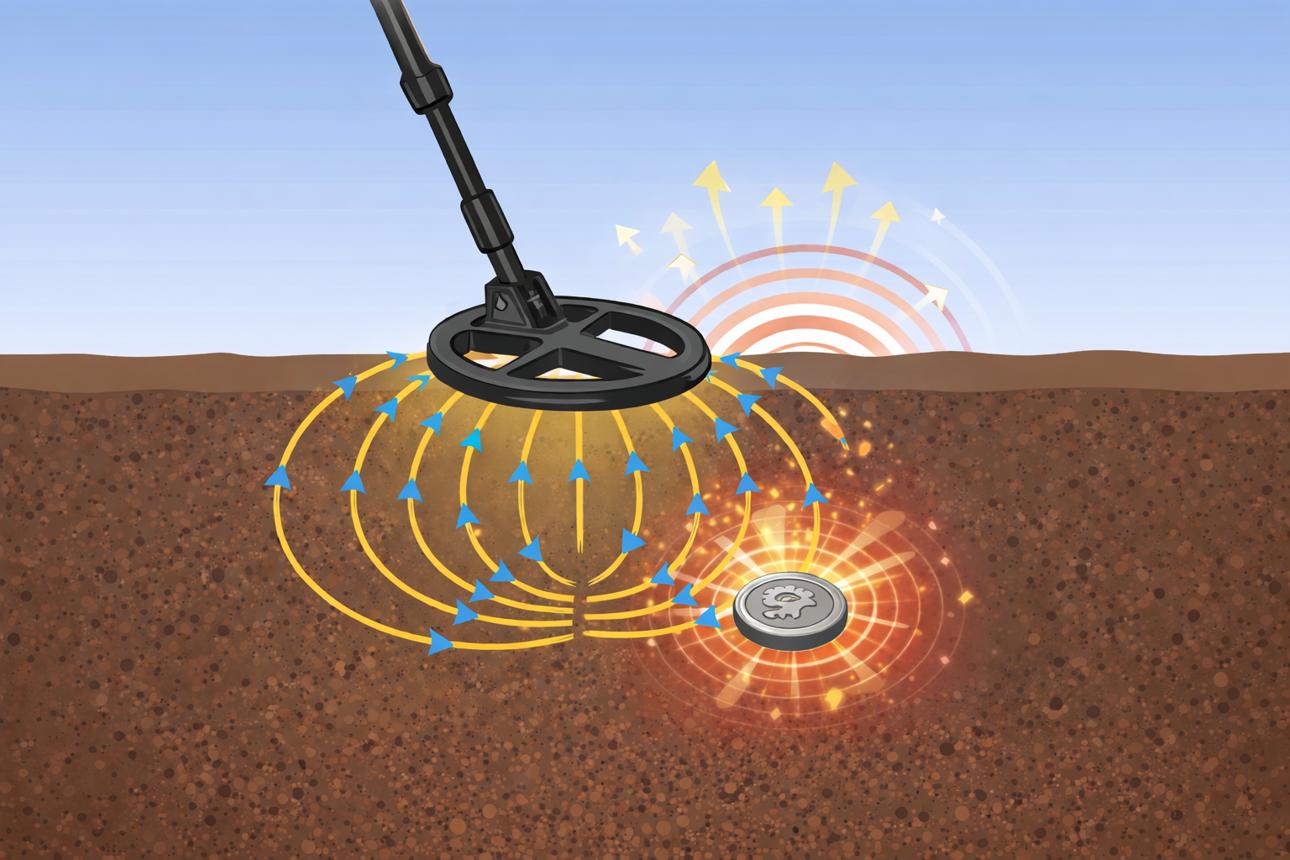
A detector's search coil has a transmitter winding that sends an alternating electromagnetic field into the ground. When that field passes through a conductive object — a coin, a gold nugget, a piece of iron — it induces a small electrical current inside the object, which in turn generates its own faint magnetic field. A separate receiver winding in the coil picks up this returning field, and the detector's electronics convert it into the tone or display reading you see and hear. No conductive or ferromagnetic material means no returning field, which is why detectors can't sense materials like diamonds, plastic, or wood.
VLF: Very Low Frequency
VLF is the most common detector technology, transmitting a continuous single frequency (or several frequencies at once, in multi-frequency machines) typically between about 3 kHz and 71 kHz. Lower frequencies handle larger, deeper targets and cope better with mineralized ground; higher frequencies are more sensitive to small, low-conductivity targets like fine gold and jewelry — which is why a dedicated gold detector like the Nokta Gold Kruzer runs at a high 61 kHz rather than a lower general-purpose frequency. VLF's main weakness is ground mineralization: iron-rich or salty soil generates its own false signals that the detector has to filter out.
Pulse Induction (PI)
Pulse Induction detectors transmit short, powerful bursts of current rather than a continuous frequency, then measure how long it takes the resulting magnetic field to decay. Highly conductive targets (like most metals) hold that field slightly longer than the surrounding ground does, and PI's electronics are built to isolate that difference. The practical result: PI technology is largely unaffected by ground mineralization, which is why heavily mineralized regions and beach/saltwater detecting favor PI units — Minelab's GPX 6000 and SDC 2300 in our range are built on this technology. The trade-off is that PI generally can't discriminate between target types as precisely as VLF, and is more oriented toward pure depth than pinpoint identification.
Ground Balance: Why It Matters So Much
Soil itself contains trace iron minerals, and a detector's coil responds to those minerals just as it responds to a real target — this is what causes the constant chatter beginners hear in mineral-rich ground. Ground balancing tunes the detector to ignore the soil's own mineral signal while still responding to real targets. Fully automatic ground balance (standard on most modern detectors, including every Nokta gold detector we carry) handles this continuously as you search; older or entry-level designs require manual adjustment at each new search location.
Target Discrimination and VDI
Once a detector confirms something is there, discrimination circuitry estimates what it might be based on how the target's conductivity compares to known references — most detectors display this as a Visual Discrimination Index (VDI) number or a segmented scale. Low numbers typically indicate iron and low-conductivity trash, mid-range numbers indicate aluminum and similar metals, and high numbers indicate copper, silver, and larger gold pieces. It's an estimate, not a certainty — small, raw (unrefined) gold in particular can sometimes read lower than expected, which is why experienced prospectors avoid dismissing every low signal in a known gold-bearing area.
Multi-Frequency: Getting Both at Once
Multi-frequency technology (Minelab's Multi-IQ and Multi-IQ+, and Nokta's SMF systems) transmits several frequencies simultaneously rather than forcing a choice between depth-friendly low frequencies and sensitivity-friendly high ones. The detector's software processes all of them together, which is part of why multi-frequency units across both brands' ranges tend to sit at higher price points — you're paying for more sophisticated real-time signal processing, not just a bigger coil.